


CCMAS Structure for Electrical and Electronic Engineering Programme
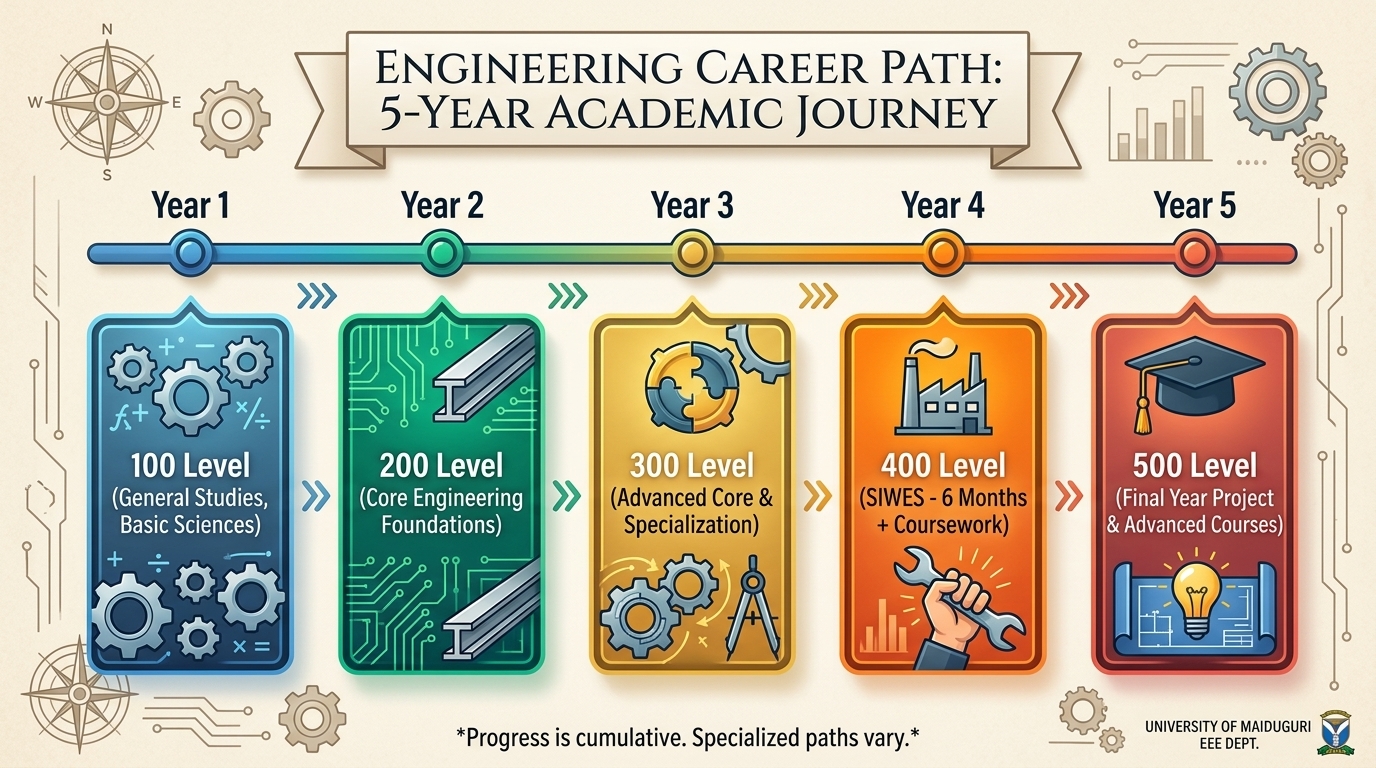
The Core Curriculum and Minimum Academic Standards (CCMAS) structure for the Bachelor of Engineering (B.Eng.) Programme in Electrical and Electronic Engineering provides a comprehensive framework for the organisation and delivery of the programme in accordance with the requirements of the National Universities Commission (NUC). The curriculum is structured to provide a progressive blend of foundational knowledge, engineering science, core Electrical and Electronic Engineering courses, practical laboratory training, design, industrial experience, and professional development.
The programme comprises General Studies, Mathematics and Basic Sciences, Engineering Fundamentals, Core Electrical and Electronic Engineering courses, laboratory practicals, electives, SIWES, and final-year engineering design/project work. Courses are systematically distributed across the levels and semesters to ensure appropriate progression in knowledge, skills, and competencies.
The CCMAS structure also promotes Outcome-Based Education (OBE) by aligning Course Learning Outcomes (CLOs) with Programme Outcomes (POs) and ensuring that students acquire the technical, practical, analytical, communication, teamwork, ethical, and professional competencies required of Electrical and Electronic Engineering graduates. The structure provides the minimum academic requirements while allowing the Department to incorporate relevant courses and emerging areas in response to technological developments and industry needs.
| SN | Course Code | Course Title | Unit | Semester | Category |
|---|---|---|---|---|---|
| 1 | CHM 101. | General Chemistry I | 2 | First | Compulsory |
| 2 | CHM 107 | General Practical Chemistry I | 1 | First | Compulsory |
| 3 | GET 101 | Engineer in Society | 1 | First | Compulsory |
| 4 | GST 111. | Communication in English | 2 | First | Compulsory |
| 5 | MTH 101. | Elementary Mathematics I | 2 | First | Compulsory |
| 6 | PHY 101. | General Physics I | 2 | First | Compulsory |
| 7 | PHY 103 | General Physics III | 2 | First | Compulsory |
| 8 | PHY 107 | General Practical Physics I | 1 | First | Compulsory |
| 9 | PHY 108 | General Practical Physics II | 1 | First | Compulsory |
| 10 | CHM 102. | General Chemistry II | 2 | Second | Compulsory |
| 11 | CHM 108 | General Practical Chemistry II | 1 | Second | Compulsory |
| 12 | EEE102. | Introduction to Electrical and Electronics Engineering | 2 | Second | Compulsory |
| 13 | GET 102 | Engineering Graphics and Solid Modelling I | 2 | Second | Compulsory |
| 14 | GST 112. | Nigerian Peoples and Culture | 2 | Second | Compulsory |
| 15 | MTH 102. | Elementary Mathematics II | 2 | Second | Compulsory |
| SN | Course Code | Course Title | Unit | Semester | Category |
|---|---|---|---|---|---|
| 1 | ENT 211 | Entrepreneurship and Innovation | 2 | First | |
| 2 | GET 201 | Applied Electricity I | 3 | First | |
| 3 | GET 205 | Fundamentals of Fluid Mechanics | 3 | First | |
| 4 | GET 209 | Engineering Mathematics I | 3 | First | |
| 5 | GET 211 | Computing and Software Engineering | 3 | First | |
| 6 | EEE 202. | Applied Electricity II | 3 | Second | |
| 7 | EEE 204 | Electrical Engineering Materials | 3 | Second | |
| 8 | GET 202 | Engineering Materials | 3 | Second | |
| 9 | GET 204 | Students Workshop Practice | 2 | Second | |
| 10 | GET 206 | Fundamentals of Thermodynamics | 3 | Second | |
| 11 | GET 208 | Strength of Materials | 3 | Second | |
| 12 | GET 210 | Engineering Mathematics II | 3 | Second | |
| 13 | GET 299 | SIWES I: Students Work Experience Scheme | 3 | Second | |
| 14 | GST 212 | Philosophy, Logic and Human Existence | 2 | Second |
| SN | Course Code | Course Title | Unit | Semester | Category |
|---|---|---|---|---|---|
| 1 | EEE 311. | Electric Circuit Theory I | 2 | First | Compulsory |
| 2 | EEE 321. | Analogue Electronic Circuits I | 2 | First | Compulsory |
| 3 | GET 301 | Engineering Mathematics III | 3 | First | Compulsory |
| 4 | GET 305 | Engineering Statistics and Data Analytics | 3 | First | Compulsory |
| 5 | GET 307 | Introduction to Artificial Intelligence, Machine Learning and Convergent Technologies | 3 | First | Compulsory |
| 6 | UNIMAID-EEE 301 | Control Systems Engineering I | 3 | First | Compulsory |
| 7 | UNIMAID-EEE 303 | Measurement and Instrumentation | 3 | First | Compulsory |
| 8 | UNIMAID-EEE 305 | Electric Power Principle I | 2 | First | Compulsory |
| 9 | EEE 322. | Digital Electronic Circuits | 2 | Second | Compulsory |
| 10 | EEE 324. | Electromagnetic Fields and Waves I | 2 | Second | Compulsory |
| 11 | EEE 326. | Electric Circuit Theory II | 2 | Second | Compulsory |
| 12 | ENT 312 | Venture Creation | 2 | Second | Compulsory |
| 13 | GET 302 | Engineering Mathematics IV | 3 | Second | Compulsory |
| 14 | GET 304 | Engineering Communication, Technical Writing and Presentation | 3 | Second | Compulsory |
| 15 | GET 306 | Renewable Energy Systems and Technology | 3 | Second | Compulsory |
| 16 | GET 399 | SIWES II: Students Work Experience Scheme | 4 | Second | Compulsory |
| 17 | GST 312 | Peace and Conflict Resolution | 2 | Second | Compulsory |